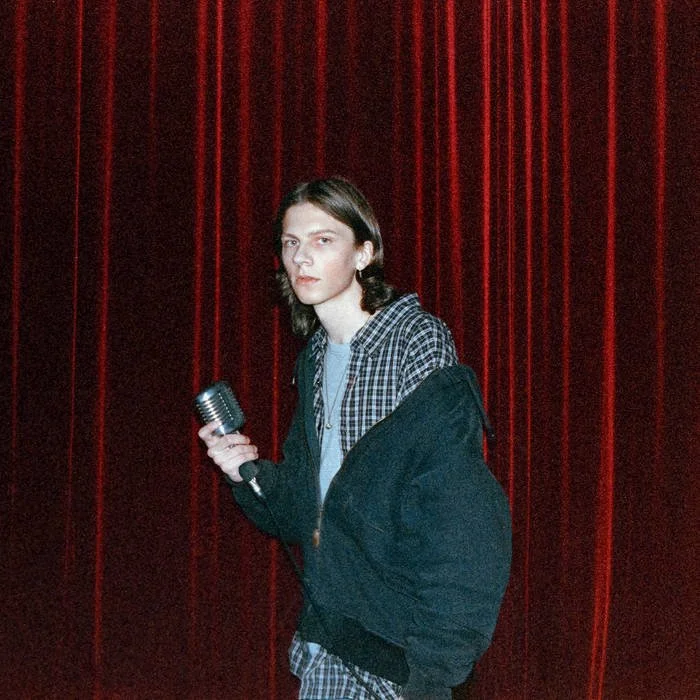
Quadeca; Proof That Change is Possible
With Quadeca's recent singles, "Dark Magic" "Baby Steps" and "Hell of a Time" we explore how the artist was able to evolve from making YouTube raps into highly respected works of art.


I find that people are often drawn to artists because of some underlying belief that they themselves could never recreate a work as eloquent, as moving, or as impressive as the one they’re viewing, it’s the “wow” factor that draws people to a museum of art. Ironically, It’s also the same reason people are drawn to the creation of art, they’d like to prove -even if only to themselves- that they could do it too, in their own little way. I’ve tried many times to convince family members and friends that they can learn to do almost anything, or that their artistic potential is much higher than they believe. Sometimes I get a hopeful response, a promise to push themselves or try something new, but it’s not often that I think the person on the other side of this conversation truly believes me when I tell them they are capable and worthy of creating meaningful art, people believe "you're either born with it or you're not" which I actively refute.
I think Quadeca (Benjamin Lasky) is a perfect example of how you truly can do anything if you work thoughtfully and intentionally at something. It’s almost a tired story at this point, and one that I’m sure Quadeca is ready to move away from, but for the sake of my argument I will set the scene.. Quadeca began his online presence in the early 2010’s with YouTube gaming content, and around 2015 transitioned into uploading his own rap music videos. I had heard some of Benjamin’s music back in this time, and even though I loved his persistence, work ethic, and love for music, I wasn’t a fan of his raps or really any of the music he was making at this time. It was very "drama YouTube beef" -esque. Years later, a close friend of mine reached out and told me to check out Quadeca’s newest album, he even mentioned that it was “much different” than the Quadeca I'd heard in the past and was worth a listen. To tell you the truth, I didn’t believe my friend at all and assumed he was into some very corny “YouTube rapper” music. I didn’t bother giving the recommendation any time of day. Another year went by and occasionally I would hear similar stories, people would say Quadeca had improved a lot, totally shifting styles, or that he underwent a very notable shift.
As a kid who grew up listening to Brockhampton with the Saturation trilogy releasing throughout my high-school years, my interest peaked in 2024 when I saw that Kevin Abstract was featured on Quadeca’s “Scrapyard” project. The song was (is) titled “Texas Blue” and was my first foray into a more appreciative relationship with Quadeca as an artist. Despite falling in love with the song and being pleasantly surprised by the purity of emotions that were able to be so gorgeously expressed throughout those five short minutes, it still wasn’t enough to break down the walls I had built around the name "Quadeca" in my mind. Isn't it a damn shame that we give so much power to a name? And made ever more powerful by the lack of conscious acknowledgement of this recognition-dismissal phenomenon. While I hadn’t the will to listen to scrapyard in its entirety, I did hear “Guide Dog” around the same time. This song is one that puts Benjamin’s vocals on clear display from the very opening moments of the track. I could no longer pretend that Quadeca was the same artist I had previously perceived him as, and indeed he did deserve my attention. Though that last statement is true, I still lived life, listened to dozens if not hundreds of other artists, worked, cried, slept, ate ramen, cried more, tripped on the pavement, etc. It wasn’t until “Vanisher, Horizon Scraper” released earlier this year that I stumbled into listening to a Quadeca album front-to-back. And it came quite easily too, what a wonderful project. Here is my favorite song from that project, "Monday"
After the first song of Vanisher auto played for me, I went directly to the album and listened from start to finish, multiple times.. How could this have been the same guy who made songs like Beamin’ and Insecure (KSI Diss Track)? It was the first time I was faced with the realization that although I had spent years trying to convince people around me that artistic growth was possible, some small part of me still didn’t entirely believe the notion myself, otherwise there shouldn’t have been nearly this much friction attached to giving Benjamin’s music a second chance. It was eye-opening to realize that in actuality, I was not attempting to convince people around me that change was possible, but really I was just trying to convince myself.
Despite my love for “Vanisher, Horizon Scraper”, it is not the project that prompted this article. Quadeca has released three singles over the few months while potentially hinting at a larger project speculated to be called “life1.” Whether or not these songs are pieces of a larger album, after listening to each of them; Dark Magic, Baby Steps, and Hell of a Time, each has become a regular addition to my playlist, songs that I would intentionally seek out to listen to again and again, I even recreated Dark Magic and did a vocal remix of it for fun just because of how much I loved the sonics and flow of Benjamin’s lyricism, as well as the wondrous harmonies (It came out terrible but was so much fun to make). This experience is so far removed from the initial one of doubt when my close friend first recommended Quadeca’s newer music. I had transitioned from being a wary listener into a fully-fledged fan, even taking hours of time to sit through production breakdown livestreams. Speaking of these livestreams, they’re in the same vein as Underscores production speedruns which I have grown to love as well, and show clearly that Benjamin hadn’t cut any corners to become the musician he is today. These breakdowns prove in real time that Quadeca had clearly understood his shortcomings as an artist and handmade his own concrete steppingstones that would lay the path to his success.
When I talk about “success” as an artist, I don’t necessarily mean monetarily, especially in this article. Benjamin had already acquired a certain level of “success” with the popularity of his YouTube channel and seeming financial freedom. This was not Benjamin’s motivator, or his goal, which I believe is a huge reason he was able to make such drastic changes over the course of just a few years. Nothing but the drive to make great music, and the feeling of accomplishment that comes from doing so could drive a person to continue the uncomfortable path of trial, error, and consistent mistakes that lead to truly great work. For many people monetary success alone would be enough to slow their roll on intentionally failing for the sake of improvement. After all, what would push you to continue learning if you were already comfortable with what you had accomplished? It seems clear to me that Benjamin was not yet comfortable with his output as an artist, which created a driving force to his continued improvement.
In a recent interview, Cameron Winter, vocalist for Geese, stated that people who are most likely to seek out the creation of art as a career, are also often the same people who are ill equipped to structure their days in a way that is conducive to steady progress and well-defined goals. As someone who is likely ill equipped myself, I fully agree with him. The fact that art can be nearly anything you choose, and has no definable limit to its worth, causes a problem of infinite possibility. Restrictions are not only necessary but can be required for you to reach project completion, especially when completion itself is such an arbitrary goal, you have to define the boundaries of that completion ahead of time so that you know what is is you’re working towards, and when it will be finished.
I’ve thought a lot about what draws me into the process of creating art, and a big part of it is the freedom that it allows in how I choose to express myself. So much freedom that the freedom itself becomes an inhibitor. My biggest struggle is enacting self-inflicted boundaries and deadlines to ensure progress and completion of projects, otherwise it’s certain I’ll stay in a state of “work” until the work itself has become so stale that I feel I’d be better off starting over, and so the cycle repeats.
...enacting self-inflicted boundaries and deadlines to ensure progress and completion of projects, otherwise I’ll stay in a state of “work” until the work itself has become so stale that I feel I’d be better off starting over, and so the cycle repeats...
Quadeca also mentioned that he had to take time away from the internet, time away from posting online, because it interfered with the process of improvement. “Being on the internet and existing publicly and always trying to remind people that you exist can detract a lot from the earnest nature of making art.” - Quadeca on Paste Magazine. He argues that the battle of shaping your outward perception is just a distraction from making the music. Instead of doing the easy thing and sitting in the success, enjoying the spoils, Quadeca chose to leave the internet and; Work. Release. Leave. Repeat. Benjamin knew what to avoid, certain behavioral patterns that were self-indulgent and would ultimately hold him back. Artists today are told to post 10 TikTok’s per day, constantly promote their music, take advantage of the internet, reach as many people as possible, I believe this is largely misleading advice. If you take the time to make truly great work - work that you would be proud to have compared to your contemporaries - and be very honest with yourself about when you feel it’s ready to promote, then I think the world would be obliged to listen. If Quadeca had posted 10 TikTok’s per day and constantly flooded my feed with every new song he made, I’m sure his progress would’ve been slowed, his focus would’ve been elsewhere, and my ill opinion of his music would’ve cemented far before I had the chance to give him a second try. After all, few people are willing to give someone a second chance, let alone a tenth, especially today when there is just too much good music to go around.
The focus should be on the art itself if your goal is to make work that you’re proud of. This doesn’t mean you should never share your work, just that there might be another aspect to consider that is contrary to the popular rhetoric online about the importance of marketing. This advice is also highly dependent on what your personal goals are when making music, because for everyone it is at least a little bit different. You might enjoy making silly songs with friends as a group activity, you might just enjoy the process of building something, enjoy the feeling of improving upon an aspect of your art you felt was lacking, or you might solely want financial success (well, I think most artists want this, but often those who do obtain it attest that it wasn’t as fulfilling as they expected, hence the importance of centering on other goals as they relate to making music). Maybe you don’t care about the money at all, and you really just want that girl in class to notice you or think you’re cool… That’s why I started, but I fell in love with the process along the way. She almost certainly does not think I’m very cool or interesting anymore, but luckily I found something to love that seems to love me back. Hopefully we can all learn to trust ourselves a little more, value our own small successes, push ourselves, be proud of our improvements, and attempt to step away from the cyclical need for social validation. If it worked for Quadeca I believe it will work for you too.
Thanks for reading, go make something beautiful.